Free · Instant · No signup
Aquarium substrate calculator
Find out exactly how many pounds of gravel, sand or aquarium soil your tank needs — from the inside dimensions, the depth you want and the material you are buying.
- Inches or centimetres
- Pounds, kilograms & litres
- Sloped beds supported
- Bag count included
Substrate calculator
Work out your substrate
Choose a standard tank or type your own inside dimensions, set the depth, and get an instant result.
Result
of aquarium gravel needed
- Metric weight
- 0 kg
- Volume
- 0 in³
- Water volume
- 0 L
- Bags to buy
- 0
Calculator categories
Pick the calculator that matches your job
Every tool shares the same engine but uses a different material density or solves a different unknown.
- Gravel
Aquarium gravel calculator
The most common substrate, weighed at 100 lb per cubic foot.
Open - Sand
Aquarium sand calculator
Fine sand packs tighter, so the same depth weighs noticeably less.
Open - Soil
Aquarium soil substrate calculator
Lightweight nutrient pellets for planted tanks and deep root systems.
Open - Depth
Aquarium substrate depth calculator
Already own the bags? Find out how far they spread across the floor.
Open - Volume
Aquarium volume calculator
Convert length, width and height into gallons and litres for dosing.
Open - All-in-one
Aquarium substrate calculator
The full tool: dimensions, slope, material, bags — all in one place.
Open
Reference
How many pounds of gravel for a 10 gallon tank?
Standard US footprints with the weight of aquarium gravel at three common depths. Use it as a sanity check against your own calculation.
| Tank | Inside size (in) | 1 in | 2 in | 3 in |
|---|---|---|---|---|
| 10 gallon | 20 × 10 | 12 lb | 23 lb | 35 lb |
| 20 gallon long | 30 × 12 | 21 lb | 42 lb | 63 lb |
| 20 gallon | 24 × 12 | 17 lb | 33 lb | 50 lb |
| 29 gallon | 30 × 12 | 21 lb | 42 lb | 63 lb |
| 40 gallon breeder | 36 × 18 | 38 lb | 75 lb | 113 lb |
| 55 gallon | 48 × 13 | 36 lb | 72 lb | 108 lb |
| 75 gallon | 48 × 18 | 50 lb | 100 lb | 150 lb |
| 125 gallon | 72 × 18 | 75 lb | 150 lb | 225 lb |
Calculated for aquarium gravel at 100 lb per cubic foot. Sand runs about 10 % lighter and aquarium soil roughly 60 % lighter — check thesoil calculatorfor those.
Visual guide
Substrate depth and weight, seen from the side
A cross-section of a sloped bed, with the depth at the front and back, the average the calculator actually uses, and what each material weighs per cubic foot.
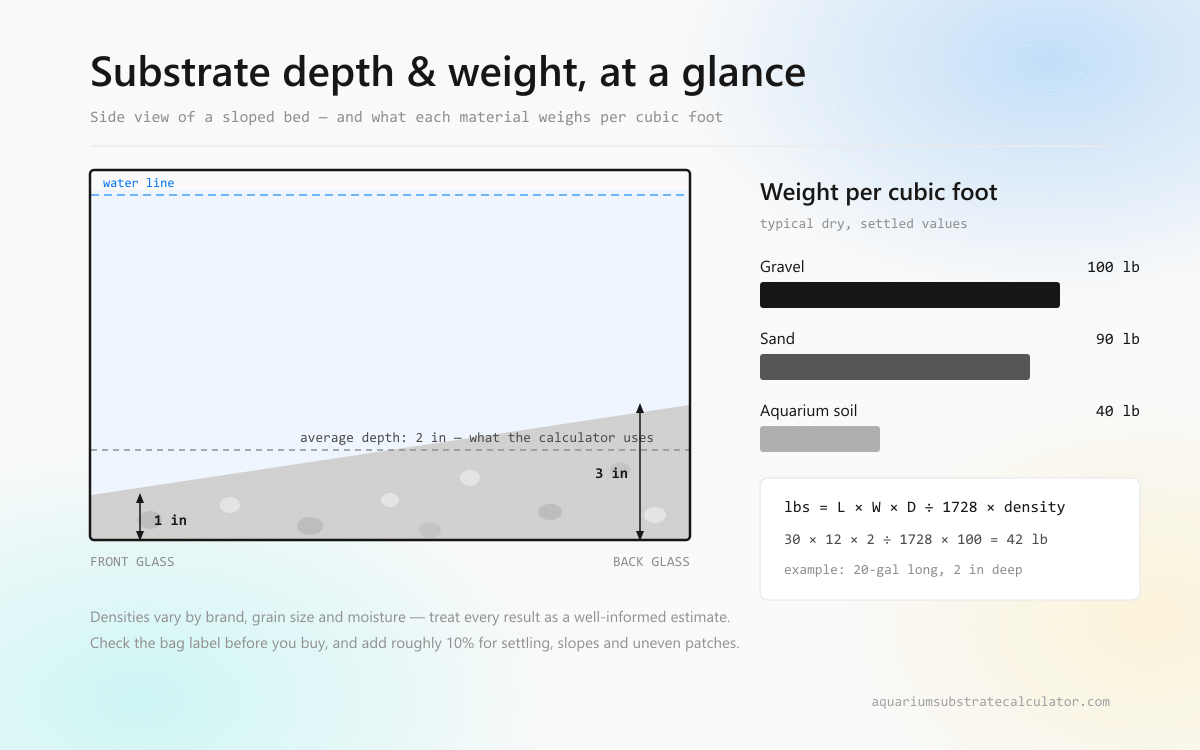
The picture above is the whole calculation in one view. Substrate quantity is avolume problem first and a weight problem second: measure the floor area of the tank, multiply by how deep the bed will sit, and you have a volume in cubic inches. Convert that volume to cubic feet by dividing by 1,728, then multiply by the density of the material you are actually buying.
The dashed line in the diagram is the detail most people miss. A bed that sits 1 inch at the front glass and 3 inches at the back behaves exactly like a flat 2-inch layer — add the two depths together and divide by two. You do not need to buy extra material for a slope, which is why the calculator's Sloped front to back mode simply averages the two figures.
The bar chart on the right is the other half of the answer. A cubic foot of aquarium gravel weighs about 100 lb, sand about 90 lb, and a lightweight planted aquarium soil only about 40 lb. That is why the same 75-gallon tank can need five bags of gravel and only two of soil for the same depth — and why anysubstrate aquarium calculator that ignores the material will give you the wrong shopping list.
Guide
Everything the aquarium substrate calculator works out for you
Why measure instead of guessing
Guessing how much substrate to buy is the fastest way to finish a setup with two spare bags in the garage, or to run out halfway through the scaping. Anaquarium substrate calculator removes the guesswork: you give it the inside length and width of the glass, the depth you want, and the material you intend to pour in, and it hands back a weight you can shop with straight away. Everything runs locally in your browser, so nothing to sign up for and no data leaves the page.
How the calculation actually works
Substrate quantity is a volume problem first and a weight problem second. Multiply the length of the tank by its width to get the footprint, then multiply that footprint by the depth of the bed to get a volume in cubic inches. Divide by 1,728 to convert cubic inches into cubic feet, then multiply by the density of your material. Aquarium gravel settles at roughly 100 pounds per cubic foot, sand at about 90 pounds, and a lightweightaquarium soil substrate at close to 40 pounds.
That density difference is why the same tank can need 75 pounds of gravel and only 30 pounds of soil. Any substrate aquarium calculator that ignores which material you are pouring will give you the wrong answer, which is why this one asks.
How many pounds of gravel for a 10 gallon tank?
A standard 10 gallon measures 20 inches by 10 inches on the inside. At one inch deep you need about 12 pounds of gravel, at two inches about 23 pounds, and at three inches about 35 pounds. The popular rule of one pound per gallon suggests only 10 pounds, but that rule ignores how shallow a 10 gallon really is — the depth-based figure is the one to trust. The table above breaks the same numbers down for 20, 29, 40, 55, 75 and 125 gallon tanks.
Choosing the right substrate depth
Most fish-only aquariums are perfectly happy with one to two inches of substrate. Planted tanks want two to three inches, rising to three or four at the back so deep-rooting stems have something to grip. Going much deeper than that in an unplanted tank creates more problems than it solves: the bed compacts, traps waste, and the lowest layers can turn anaerobic. Our aquarium substrate depth calculator runs the same maths in reverse — tell it how many pounds you already own and it tells you how far they spread.
Sloping the bed
A bed that sits one inch at the front and three inches at the back behaves, for volume purposes, exactly like a flat two-inch layer — add the two depths and divide by two. Sloping is worth the extra material: it pushes the focal point upwards, hides detritus at the front glass and gives roots more room at the rear. Toggle the calculator above toSloped front to back and it averages the two figures for you.
Gravel, sand or aquarium soil?
Gravel is the default for a reason. Its open grain lets water circulate through the bed, which keeps the beneficial bacteria fed and the filter working. Sand looks more natural and suits burrowing species, but it packs tighter, needs occasional stirring and shows debris faster. Aquarium soil is a different product altogether — lightweight, nutrient-rich pellets designed for planted tanks, and the reason a single bag covers so much more floor area than a bag of gravel.
Buy a little extra
Whatever you pick, add roughly ten percent to the result. Settling, sloping and the inevitable uneven patch all cost material, and running out mid-scrape means a second trip to the shop. Enter your numbers above for the exact figure, round up to whole bags, and start rinsing.
Expertise & experience
Substrate buying, explained by the people who built the calculator
Method, sources, first-hand experience and honest limits — so you can judge the numbers for yourself rather than take them on faith.
How we source our densities
Every weight this site returns depends on one number: how much a settled cubic foot of material weighs. We use the loose, dry, settled figures that are standard across the aquarium trade — approximately 100 lb per cubic foot for aquarium gravel, 90 lb for sand, and 40 lb for lightweight planted soils such as aquarium soil. These are not marketing numbers; they are the same figures you can derive yourself from any bag label that lists both weight and volume. A 20 lb bag of gravel that claims to contain 0.2 cubic feet, for example, is telling you its density is 100 lb per cubic foot.
We deliberately do not use one universal density for all materials. The difference between gravel and planted soil is a factor of 2.5, which is the difference between buying five bags and buying two for the same tank. Any calculator that skips this step is giving you a plausible-looking number that is wrong by more than 100%.
Where the formula comes from
The arithmetic is basic geometry, not estimation. Substrate volume is a rectangular prism: inside length × inside width × bed depth, in cubic inches. There are 1,728 cubic inches in a cubic foot, so dividing by 1,728 converts the volume to cubic feet. Multiplying by the material density gives pounds. Every step is shown on this page and in the worked examples, so you can check the calculator against your own arithmetic — and we would rather you did.
The only judgement call in the whole chain is depth, and that depends on what your tank is for. A fish-only community tank does its job with 1–2 inches of gravel; a planted tank needs 2–3 inches to give stems a root zone; a burrowing species such as a kuhli loach or a goby wants sand deep enough to disappear into, which means 3+ inches. Where depth is concerned we give ranges rather than a single number, because a single number would be false precision.
What we have learned from real setups
A few practical lessons that the pure arithmetic does not teach you, but that change what you should buy:
- Sand weighs more than it looks. A 20-lb bag of fine sand fills noticeably less floor area than a 20-lb bag of gravel at the same nominal depth, because the grains pack tighter and trap less air. If you are switching from gravel to sand, recalculate — do not assume the bag count carries over.
- Settling is real. Freshly poured substrate has air pockets between the grains. Over the first few weeks of water changes it compresses, typically by 5–10%. This is the single biggest reason to buy the extra 10% the calculator suggests.
- Hardscape displaces volume. Large pieces of driftwood or dragon stone that sit on the glass take up floor area. If your layout covers more than about 15% of the footprint with hardscape, trim that much off the result.
- Sloping saves nothing but looks better. As the diagram above shows, a 1-in-to-3-in slope uses exactly the same material as a flat 2-in bed. You get the visual depth of a 3-inch rear bed for the price of a 2-inch one.
- Planted substrates are sold by litre, not pound. Aquasoils are lightweight on purpose — that is what makes them good for plant roots and bad for converting between units in your head. Our soil calculatorhandles the litre/pound swap for you.
Mistakes we see constantly
Using the “one pound per gallon” rule. This rule of thumb circulates in every aquarium forum, and it is not wrong so much as incomplete. It was derived for a standard 10-gallon tank at a moderate 2-inch depth. Applied to a 4-foot 55-gallon with a 1-inch bed it over-buys; applied to a shallow 20-gallon long it under-buys. Rules of thumb break precisely when tanks stop being cubic — and almost no tank is cubic. Measuring your footprint takes thirty seconds and never breaks.
Measuring the outside of the tank. Glass thickness, silicone seams and plastic trim all eat into the inside dimensions. On a standard 4-foot tank the difference is about an inch of length — roughly 6% of your footprint and therefore 6% of your shopping list. Measure from the inside of the glass, at the bottom where the substrate will actually sit.
Buying the exact amount. Under-buying by even one bag means a second trip to the shop mid-scrape, and substrate from a different batch may not match in colour or grain size. The calculator rounds up to whole bags for this reason.
Planning the slope and calculating for the maximum depth. If you plan 3 inches at the back, do not calculate for 3 inches everywhere. Use the average, or the depth calculator in reverse: enter the pounds you can carry home and see how far they actually spread.
When deeper is not better
There is a point past which more substrate starts working against you. Below about three inches of gravel — or four of planted soil — the lowest layers can turn anaerobic: bacteria consume the trapped oxygen, the chemistry shifts, and disturbing the layer releases hydrogen sulfide with its characteristic rotten-egg smell. Dense beds also compact over time, slowing water circulation and trapping detritus where your filter cannot reach it.
The defence is to keep depth sensible, plant densely so roots channel water downward, and stir the front third of the bed gently during maintenance rather than letting it set like concrete. If you are unsure whether your planned depth is safe, thesubstrate depth calculator shows you the depth your existing material will reach, which makes the anaerobic risk easy to judge before you ever fill the tank.
How this site stays honest
We do not accept payment for calculator rankings, we do not bury the tool under advertising, and every result is computed locally in your browser from the numbers you typed — nothing is stored and no data leaves the page. The maths is printed in full on this page so that a stranger with a spreadsheet can reproduce any figure we return. If you spot a density that looks off, a preset that does not match a real tank, or a unit conversion that misbehaves, we want to know: send it through thecontact page and we will check it against the source and fix it. The about page explains how the figures were compiled in the first place.
Ready to work out your tank?
Enter your inside dimensions, set the depth, choose your material and get pounds, kilograms, litres and a bag count instantly — or read thefull substrate buying guide first if you would rather understand every step before you calculate.
Reviewed for accuracy by the calculator team
Densities follow standard aquarium-trade figures (gravel 100 lb/ft³, sand 90, soil 40) and every formula on this page is shown in full so you can verify it. Last reviewed: 14 November 2026. Found an error? Tell us.
Answers
Frequently Asked Questions
Straight answers to the questions we see most, with links to the calculator that works each one out exactly.
01How much substrate do I need for my aquarium?
Measure the inside length and width of the tank, decide how deep you want the bed, then multiply: length × width × depth = volume. Multiply that volume by the density of the material to get weight. Our aquarium substrate calculator does it for you in inches or centimetres and returns pounds, kilograms, litres and the number of bags to buy.
As a starting point, use 1–2 inches for a fish-only tank and 2–3 inches for a planted setup. Always buy roughly 10% extra for settling and sloping.
02How many lbs of substrate for 55 gallons?
A standard 55 gallon tank has a 48 × 13 inch footprint. With gravel at about 100 lb per cubic foot you need roughly 36 lbs at 1 inch, 72 lbs at 2 inches and 108 lbs at 3 inches.
The old rule of thumb — 1 to 1.5 lbs per gallon — gives you 55 to 82 lbs, which matches a 1.5 to 2 inch bed. Run your exact numbers through the substrate calculator before you shop.
03How many lbs of substrate for 20 gallons long?
A 20 gallon long measures 30 × 12 inches inside, so the footprint is larger than a standard 20 gallon. You will need about 21 lbs at 1 inch, 42 lbs at 2 inches and 63 lbs at 3 inches of gravel. Sand comes in slightly lighter at around 38 lbs for a 2 inch bed.
Compare tank shapes with the aquarium volume calculator if you are still deciding between a long and a standard footprint.
04Is 4 inches of substrate too much?
For most community and fish-only tanks, yes — 4 inches is deeper than you need and it makes vacuuming the bed awkward. Two to three inches is the practical ceiling for gravel.
Four inches becomes reasonable when you are building a planted aquarium with deep-rooting stems such as vallisneria or sword plants, because you need the volume to anchor roots and hold nutrients. If you go deep, slope the bed down towards the front glass so the lowest layer still gets some circulation.
05Can you put too much substrate in a fish tank?
Yes. An overly deep bed compacts, traps fish waste and uneaten food, and can turn anaerobic — the layer that produces hydrogen sulfide gas and a rotten-egg smell. It also cuts into swimming space, adds real weight to the stand, and makes gravel vacuuming slower.
Stay inside the 1 to 3 inch range for gravel and 2 to 4 inches for a dedicated substrate depth in a planted tank, and stir the deeper layers occasionally.
06Do fish prefer light or dark substrate?
There is no single answer — it depends on the species and on the look you want. Tetras, rasboras, loaches and most cichlids colour up more strongly and settle faster over a dark bed, because it matches the shadows they would hide in in the wild. Bottom feeders such as corydoras and kuhli loaches are often sold on bare or light sand, and they show natural foraging behaviour on a pale, fine substrate.
Light substrate also makes detritus and algae more visible, so it needs more frequent cleaning. Pick the colour for your fish first, then confirm the weight with the sand calculator.
07How deep should substrate be in an aquarium?
1–2 inches is enough for a fish-only or lightly planted tank. 2–3 inches suits most planted setups, and 3–4 inches is justified for deep-rooting plants or a layered soil-and-gravel bed. Slope it 1 inch higher at the back to create depth in the aquascape.
Our aquarium substrate depth calculator works the other way round: tell it how much material you already own and it tells you how far that spread across your footprint.
08What color light kills algae?
No visible bulb colour kills algae. Algae grow when they have light, nutrients and time, and changing the colour of the lamp does not remove any of those three. Blue and actinic light look dramatic but they still grow algae, and green light is simply reflected rather than destroyed.
What actually works is shortening the photoperiod to 6–8 hours, dimming the intensity, feeding less so fewer nutrients reach the water, and adding fast-growing plants or a clean-up crew. If you are setting up a planted tank, size the substrate and lighting together with the aquarium soil substrate calculator.
09What is the most common cause of fish death in aquariums?
New tank syndrome — ammonia and nitrite poisoning in an aquarium whose filter has not finished cycling — is the leading cause of fish loss, and it accounts for the majority of first-time deaths. After that come overfeeding and poor water quality, then temperature or pH shock from sudden water changes.
Substrate plays a quiet role: an over-deep bed traps waste and adds to the organic load, so keeping the depth sensible and vacuuming regularly protects water quality. Check your footprint with the volume calculator before dosing water treatments.
10How many pounds of gravel for a 10 gallon tank?
A standard 10 gallon has a 20 × 10 inch footprint. Using gravel at 100 lb per cubic foot, you need about 12 lbs for a 1 inch bed, 17 lbs at 1.5 inches and 23 lbs at 2 inches.
The quick "1 lb per gallon" estimate says 10 lbs, but that rule ignores how shallow a 10 gallon actually is — the depth-based figure above is the one to trust. Enter 20 × 10 and your chosen depth in the aquarium substrate calculator for the exact number.
11How much substrate does a planted aquarium need?
Plan on 2 to 3 inches as a base, rising to 3 or 4 inches at the back. A nutrient-rich aquarium soil substrate lets you go slightly shallower than gravel because every granule feeds the roots, while inert sand and gravel need root tabs to do the same job.
Layering works well: 1.5 inches of soil capped with 1 inch of sand or fine gravel keeps the nutrients in place and stops the water clouding up.
12What is the difference between gravel, sand and soil calculators?
The maths is identical — footprint times depth — but the density changes the answer. Gravel settles at about 100 lb per cubic foot, sand at about 90 lb, and lightweight aquarium soil at roughly 40 lb. The same 2 inch bed in a 40 gallon breeder needs about 75 lbs of gravel but only 30 lbs of soil.
Use the gravel calculator, the sand calculator or the soil calculator so the density matches what is actually in the bag.
13How do I calculate substrate for a sloped tank?
Add the front depth to the back depth and divide by two, then treat that average as a uniform layer. A bed that runs 1 inch at the front and 3 inches at the back behaves like a flat 2 inch layer for volume purposes.
Sloping is worth doing: it pushes the focal point up, hides detritus at the front and gives roots more room at the rear. Our substrate depth calculator accepts both the shallow and deep end and works out the average for you.
14How many bags of substrate do I need to buy?
Convert the weight you need into the bag size sold near you, then round up — 42 lbs of gravel is three 15 lb bags, not two. It is worth buying one extra bag, because settling, sloping and the inevitable uneven patch all cost material.
The calculator returns a bag count for 5, 10, 20 and 25 lb packaging alongside pounds and kilograms, so you can shop straight from the result.
15Should I rinse new aquarium substrate before adding it?
For gravel and sand, yes. Rinse in a bucket of cool tap water, stirring and decanting until the water runs clear — this removes the dust that otherwise clouds the tank for days. A fine sand bed can take five or six changes of water.
Planted soils are the exception: many manufacturers say not to rinse them, because the granules break down and you will wash away the nutrients. Check the bag, then measure the depth you have left with the depth calculator.
Still stuck? Ask usor re-run the substrate calculator with different numbers.
Ready to fill the tank?
Run your dimensions through the calculator and take an exact bag count to the shop.